


The Canadian Thanksgiving Day came about because of a combination of traditions.
 Before the first Europeans arrived in North America, the farmers in Europe held
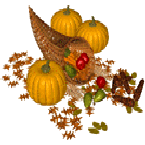
celebrations at harvest time. The farm workers filled a curved goat's horn with
fruit and grain to give thanks for their harvest having been a good one.
This horn was called a Horn of Plenty.....or a Cornucopia, and the farm
workers who started a new life in Canada took this tradition with them.
Before the first Europeans arrived in North America, the farmers in Europe held
celebrations at harvest time. The farm workers filled a curved goat's horn with
fruit and grain to give thanks for their harvest having been a good one.
This horn was called a Horn of Plenty.....or a Cornucopia, and the farm
workers who started a new life in Canada took this tradition with them.
In Newfoundland in 1578, the English navigator Martin Frobisher held a
ceremony to give thanks for surviving the long journey. He was later
knighted and had an inlet of the Atlantic Ocean in Northern Canada named
after him.....Frobisher Bay. As other settlers arrived they continued
these ceremonies.
In 1621, in what is now the United States of America, the Pilgrims
celebrated their harvest in the New World. By the 1750's settlers
 moving to Canada from America had taken this celebration to Nova Scotia.
At the same time, French settlers arriving in Canada with the explorer
Samuel de Champlain held thanksgiving feasts and shared their food with
their Indian neighbours. After the seven years war ended in 1763 the
citizens of Halifax held a special day of Thanksgiving.
moving to Canada from America had taken this celebration to Nova Scotia.
At the same time, French settlers arriving in Canada with the explorer
Samuel de Champlain held thanksgiving feasts and shared their food with
their Indian neighbours. After the seven years war ended in 1763 the
citizens of Halifax held a special day of Thanksgiving.
 At the time of the American Revolution, the people who remained loyal
to the Government in England moved to Canada and spread the Thanksgiving
celebration to other parts of the country. Other English settlers were
also used to having a harvest celebration in their churches every Autumn.
At the time of the American Revolution, the people who remained loyal
to the Government in England moved to Canada and spread the Thanksgiving
celebration to other parts of the country. Other English settlers were
also used to having a harvest celebration in their churches every Autumn.

In 1879 the Canadian Parliament declared the 6th of November as a day of
Thanksgiving and a national holiday. Over the years the date has
changed with the third Monday in October being the most popular time.
Finally on the 31st January 1957 the Canadian Parliament proclaimed that....
'A Day of General Thanksgiving to Almighty God
for the bountiful harvest with which Canada has
been blessed.....
to be observed on the second Monday in October.'

| Canadian Thanksgiving | Year | The Second Monday in October |
|---|---|


When the Pilgrims crossed the Atlantic Ocean in 1620,
they landed on the rocky shores of a territory that was
inhabited by the Wampanoag (Wam pa NO ag) Indians. The
 Wampanoags were part of the Algonkian-speaking peoples, a
large group that was part of the Woodland Culture area.
These Indians lived in villages along the coast of what is
now Massachusetts and Rhode Island. They lived in round-
roofed houses called wigwams. These were made of poles
covered with flat sheets of elm or birch bark. Wigwams
differ in construction from tipis that were used by Indians
of the Great Plains.
Wampanoags were part of the Algonkian-speaking peoples, a
large group that was part of the Woodland Culture area.
These Indians lived in villages along the coast of what is
now Massachusetts and Rhode Island. They lived in round-
roofed houses called wigwams. These were made of poles
covered with flat sheets of elm or birch bark. Wigwams
differ in construction from tipis that were used by Indians
of the Great Plains.
The Wampanoags moved several times during each year in order to get food. In the spring they would fish in the rivers for salmon and herring. In the planting season they moved to the forest to hunt deer and other animals. After the end of the hunting season people moved inland where there was greater protection from the weather. From December to April they lived on food that they stored during the earlier months.
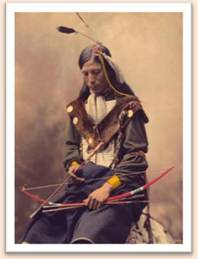
The basic dress for men was the breech clout, a length of deerskin looped over a belt in back and in front. Women wore deerskin wrap-around skirts. Deerskin leggings and fur capes made from deer, beaver, otter, and bear skins gave protection during the colder seasons, and deerskin moccasins were worn on the feet. Both men and women usually braided their hair and a single feather was often worn in the back of the hair by men. They did not have the large feathered headdresses worn by people in the Plains Culture area.
There were two language groups of Indians in New
England at this time. The Iroquois were neighbours to the
Algonkian-speaking people. Leaders of the Algonquin and
Iroquois people were called "sachems" (SAY chems). Each
village had its own sachem and tribal council. Political
power flowed upward from the people. Any individual, man or
woman, could participate, but among the Algonquins more
 political power was held by men. Among the Iroquois,
however, women held the deciding vote in the final
selection of who would represent the group. Both men and
women enforced the laws of the village and helped solve
problems. The details of their democratic system were so
impressive that about 150 years later Benjamin Franklin
invited the Iroquois to Albany, New York, to explain their
system to a delegation who then developed the "Albany Plan
of Union." This document later served as a model for the
Articles of Confederation and the Constitution of the
United States.
political power was held by men. Among the Iroquois,
however, women held the deciding vote in the final
selection of who would represent the group. Both men and
women enforced the laws of the village and helped solve
problems. The details of their democratic system were so
impressive that about 150 years later Benjamin Franklin
invited the Iroquois to Albany, New York, to explain their
system to a delegation who then developed the "Albany Plan
of Union." This document later served as a model for the
Articles of Confederation and the Constitution of the
United States.
These Indians of the Eastern Woodlands called the turtle, the deer and the fish their brothers. They respected the forest and everything in it as equals. Whenever a hunter made a kill, he was careful to leave behind some bones or meat as a spiritual offering, to help other animals survive. Not to do so would be considered greedy. The Wampanoags also treated each other with respect. Any visitor to a Wampanoag home was provided with a share of whatever food the family had, even if the supply was low. This same courtesy was extended to the Pilgrims when they met.
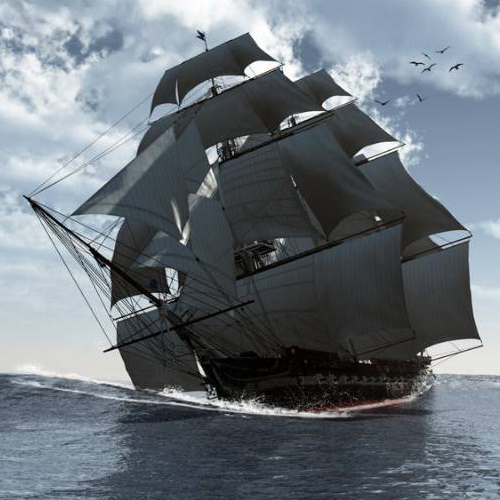
We can only guess what the Wampanoags must have thought when they first saw the strange ships of the Pilgrims arriving on their shores. But their custom was to help visitors, and they treated the newcomers with

courtesy. It was mainly because of their kindness that the Pilgrims survived at all. The wheat the Pilgrims had brought with them to plant would not grow in the rocky soil. They needed to learn new ways for a new world, and the man who came to help them was called "Tisquantum" (Tis SKWAN tum) or "Squanto" (SKWAN toe).
Squanto was originally from the village of Patuxet (Pa
TUK et) and a member of the Pokanokit Wampanoag nation.
Patuxet once stood on the exact site where the Pilgrims
built Plymouth. In 1605, fifteen years before the Pilgrims
came, Squanto went to England with a friendly English
explorer named John Weymouth. He had many adventures and
 learned to speak English. Squanto came back to New England
with Captain Weymouth. Later Squanto was captured by a
British slaver who raided the village and sold Squanto to
the Spanish in the Caribbean Islands. A Spanish Franciscan
priest befriended Squanto and helped him to get to Spain
and later on a ship to England. Squanto then found Captain
Weymouth, who paid his way back to his homeland. In England
Squanto met Samoset of the Wabanake (Wab NAH key) Tribe,
who had also left his native home with an English explorer.
They both returned together to Patuxet in 1620. When they
arrived, the village was deserted and there were skeletons
everywhere. Everyone in the village had died from an
illness the English slavers had left behind. Squanto and
Samoset went to stay with a neighbouring village of
Wampanoags.
learned to speak English. Squanto came back to New England
with Captain Weymouth. Later Squanto was captured by a
British slaver who raided the village and sold Squanto to
the Spanish in the Caribbean Islands. A Spanish Franciscan
priest befriended Squanto and helped him to get to Spain
and later on a ship to England. Squanto then found Captain
Weymouth, who paid his way back to his homeland. In England
Squanto met Samoset of the Wabanake (Wab NAH key) Tribe,
who had also left his native home with an English explorer.
They both returned together to Patuxet in 1620. When they
arrived, the village was deserted and there were skeletons
everywhere. Everyone in the village had died from an
illness the English slavers had left behind. Squanto and
Samoset went to stay with a neighbouring village of
Wampanoags.
One year later, in the spring, Squanto and Samoset were hunting along the beach near Patuxet. They were startled to see people from England in their deserted village. For several days, they stayed nearby observing the newcomers. Finally they decided to approach them. Samoset walked into the village and said "welcome," Squanto soon joined him. The Pilgrims were very surprised to meet two Indians who spoke English.
The Pilgrims were not in good condition. They were
living in dirt-covered shelters, there was a shortage of
food, and nearly half of them had died during the winter.
They obviously needed help and the two men were a welcome
sight. Squanto, who probably knew more English than any
other Indian in North America at that time, decided to stay
with the Pilgrims for the next few months and teach them
 how to survive in this new place. He brought them deer meat
and beaver skins. He taught them how to cultivate corn and
other new vegetables and how to build Indian-style houses.
He pointed out poisonous plants and showed how other plants
could be used as medicine. He explained how to dig and cook
clams, how to get sap from the maple trees, use fish for
fertilizer, and dozens of other skills needed for their
survival.
how to survive in this new place. He brought them deer meat
and beaver skins. He taught them how to cultivate corn and
other new vegetables and how to build Indian-style houses.
He pointed out poisonous plants and showed how other plants
could be used as medicine. He explained how to dig and cook
clams, how to get sap from the maple trees, use fish for
fertilizer, and dozens of other skills needed for their
survival.
By the time fall arrived things were going much better for the Pilgrims, thanks to the help they had received. The corn they planted had grown well. There was enough food to last the winter. They were living comfortably in their Indian-style wigwams and had also managed to build one European-style building out of squared logs. This was their church. They were now in better health, and they knew more about surviving in this new land. The Pilgrims decided to have a thanksgiving feast to celebrate their good fortune. They had observed thanksgiving feasts in November as religious obligations in England for many years before coming to the New World.
The Algonkian tribes held six thanksgiving festivals during the year. The beginning of the Algonkian year was marked by the Maple Dance which gave thanks to the Creator for the maple tree and its syrup. This ceremony occurred

when the weather was warm enough for the sap to run in the maple trees, sometimes as early as February. Second was the planting feast, where the seeds were blessed. The strawberry festival was next, celebrating the first fruits of the season. Summer brought the green corn festival to give thanks for the ripening corn. In late fall, the harvest festival gave thanks for the food they had grown. Mid-winter was the last ceremony of the old year. When the Indians sat down to the "first Thanksgiving" with the Pilgrims, it was really the fifth thanksgiving of the year for them!
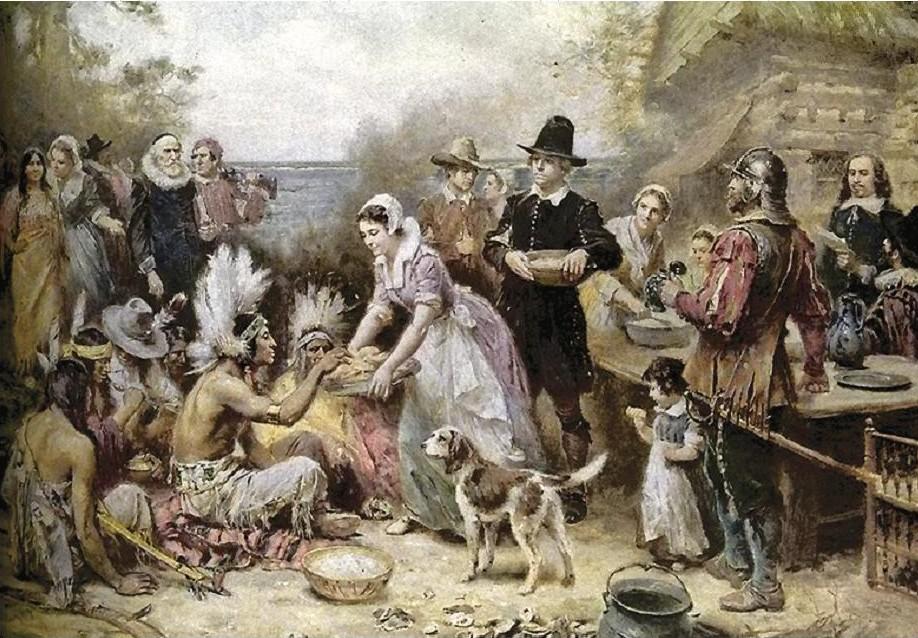
Captain Miles Standish, the leader of the Pilgrims, invited Squanto, Samoset, Massasoit (the leader of the Wampanoags), and their immediate families to join them for a celebration, but they had no idea how big Indian families could be.
As the Thanksgiving feast began, the Pilgrims were overwhelmed at the large turnout of ninety relatives that Squanto and Samoset brought with them. The Pilgrims were not prepared to feed a gathering of people that large for three days. Seeing this, Massasoit gave orders to his men within the first hour of his arrival to go home and get more food. Thus it happened that the Indians supplied the majority of the food: Five deer, many wild turkeys, fish, beans, squash, corn soup, corn bread, and berries. Captain Standish sat at one end of a long table and the Clan Chief Massasoit sat at the other end. For the first time the Wampanoag people were sitting at a table to eat instead of on mats or furs spread on the ground. The Indian women sat together with the Indian men to eat. The Pilgrim women, however, stood quietly behind the table and waited until after their men had eaten, since that was their custom.
For three days the Wampanoags feasted with the Pilgrims. It was a special time of friendship between two very different groups of people. A peace and friendship agreement was made between Massasoit and Miles Standish giving the Pilgrims the clearing in the forest where the old Patuxet village once stood to build their new town of Plymouth.
It would be very good to say that this friendship lasted a long time; but, unfortunately, that was not to be. More English people came to America, and they were not in need of help from the Indians as were the original Pilgrims. Many of the newcomers forgot the help the Indians had given them. Mistrust started to grow and the friendship weakened. The Pilgrims started telling their Indian neighbours that their Indian religion and Indian customs were wrong. The Pilgrims displayed an intolerance toward the Indian religion similar to the intolerance displayed toward the less popular religions in Europe. The relationship deteriorated and within a few years the children of the people who ate together at the first Thanksgiving were killing one another in what came to be called King Phillip's War.

It is sad to think that this happened, but it is important to understand all of the story and not just the happy part. Today the town of Plymouth Rock has a Thanksgiving ceremony each year in remembrance of the first Thanksgiving. There are still Wampanoag people living in Massachusetts. In 1970, they asked one of them to speak at the ceremony to mark the 350th anniversary of the Pilgrim's arrival. Here is part of what was said:
"Today is a time of celebrating for you -- a time of looking back to the first days of white people in America. But it is not a time of celebrating for me. It is with a heavy heart that I look back upon what happened to my People. When the Pilgrims arrived, we, the Wampanoags, welcomed them with open arms, little knowing that it was the beginning of the end. That before 50 years were to pass, the Wampanoag would no longer be a tribe. That we and other Indians living near the settlers would be killed by their guns or dead from diseases that we caught from them. Let us always remember, the Indian is and was just as human as the white people.
Although our way of life is almost gone, we, the
Wampanoags, still walk the lands of Massachusetts. What has
happened cannot be changed. But today we work toward a
better America, a more Indian America where people and
nature once again are important."

The first recorded Thanksgiving observance was held on June 29,
1671 at Charlestown, Massachusetts by proclamation of the town's
 governing council.
During the 1700s, it was common practice for individual colonies
to observe days of thanksgiving throughout each year.
In 1939, President Franklin D. Roosevelt moved the holiday to the
third Thursday of November (to extend the Christmas shopping season
and boost the economy).
After a storm of protest, Roosevelt changed
the holiday again in 1941 to the fourth Thursday in November, where
it stands today.
| USA Thanksgiving | Year | The Fourth Thursday in November |
|---|---|



5 myths about the First Thanksgiving - Printable document

CDN Celebrations | My Canada | New Years | Valentine's Day | St. Patrick's Day | Easter | Mother's Day | Father's Day | Canada Day | Halloween | Remembrance Day | Christmas
 Canadian Holidays
A Perpetual Table of Holidays Observed in Ontario

 e-mail:
jimandgloria@yahoo.com
e-mail:
jimandgloria@yahoo.com


Thank you for visiting us on the World Wide Web.
Copyright © 2000 -
All rights reserved.
Design by
Φ
Unicorn JIF 2007 2008
All suggestions, Broken Links, Corrections and Recommendations
must be submitted to WebMaster
 Send e-mail to:
WebMaster
jimandgloria@yahoo.com
Send e-mail to:
WebMaster
jimandgloria@yahoo.com
